Alessandro Donà | Michele Novi | Giuseppe Porcellini |
Luigi Tarallo | Gian Mario Micheloni | Andrea Giorgini | Paolo Paladin | Fabio Catani
Introduction
The number of shoulder replacements in recent years has grown exponentially, especially after the increased utilization of reverse total shoulder arthroplasty (RSA) in the last decade, both in USA and Europe. (1–5)
RSA success and reliability has widened indications, from cuff tear arthropathy to rheumatoid arthritis, complex proximal humerus fractures and their sequelae, failed shoulder arthroplasty, tumors and revisions of primary implants. (6–8)
An increasing number of shoulder implants has also resulted in an increase in the rate of associated compli- cations. Complications that can occur after a shoulder replacement include instability, infection, scapular notching, and periprosthetic fractures. Periprosthetic shoulder fractures represent an uncommon but severe complication. The frequency of periprosthetic humeral fractures after shoulder arthroplasty ranges from 1.6 to 2.8% for total replacement and up to 2.3% for hemiarthroplasty. (9–13)
Periprosthetic fractures in reverse shoulder arthroplasty (RSA) are three times more frequent than anatomic ar- throplasty and account for approximately 20% of all complications,14 affecting the humerus, the glenoid, or the acromion.
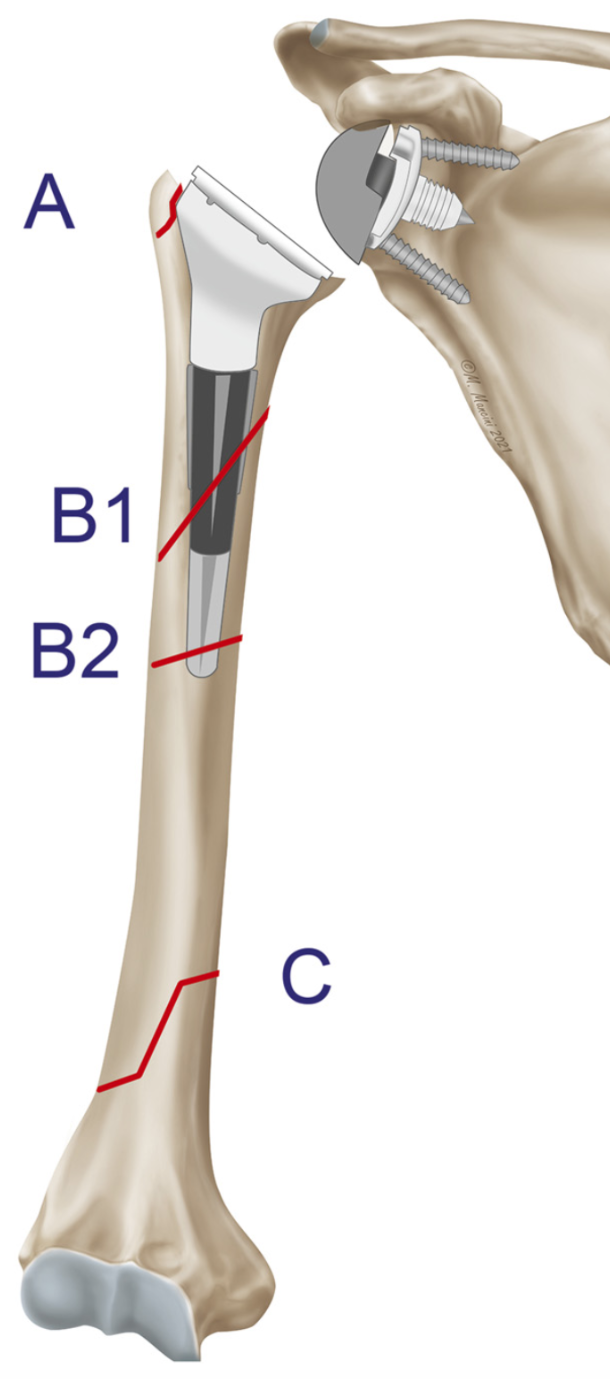
Depending on the location and morphology of the fracture, different classifications have been proposed; however, best treatment protocols are still debated. (10-15)
Risk factors associated with PHF are represented by a reduced bone stock, female sex, advanced age, higher Deyo-Charlson comorbidity index, and a history of rheumatoid arthritis. (16)
In addition to biological factors, also the characteristics and design of the implants may influence the risk of periprosthetic fracture. For these reasons, further classification has been proposed according to typology of the prosthesis. (17)
This study retrospectively analyzed all the peri- prosthetic humeral fractures (PHF) occurred in a period of 10 years treated surgically. We classi ed the different fractures in association with an analysis of risk factors, the radiographical cortical index, and the type of implant used. Analyzing the type of treatment performed, we then evaluated the functional outcomes, the healing rates, and the associated complications, with an average follow-up of 5 years.
Clicca sul pulsante sottostante per continuare nella lettura dell’articolo completo e visualizzare le immagini di approfondimento.