Alessandro Donà | Luigi Tarallo | Michele Novi | Giuseppe Porcellini | Andrea Giorgini | Gianmario Micheloni | Fabio Catani
Introduction
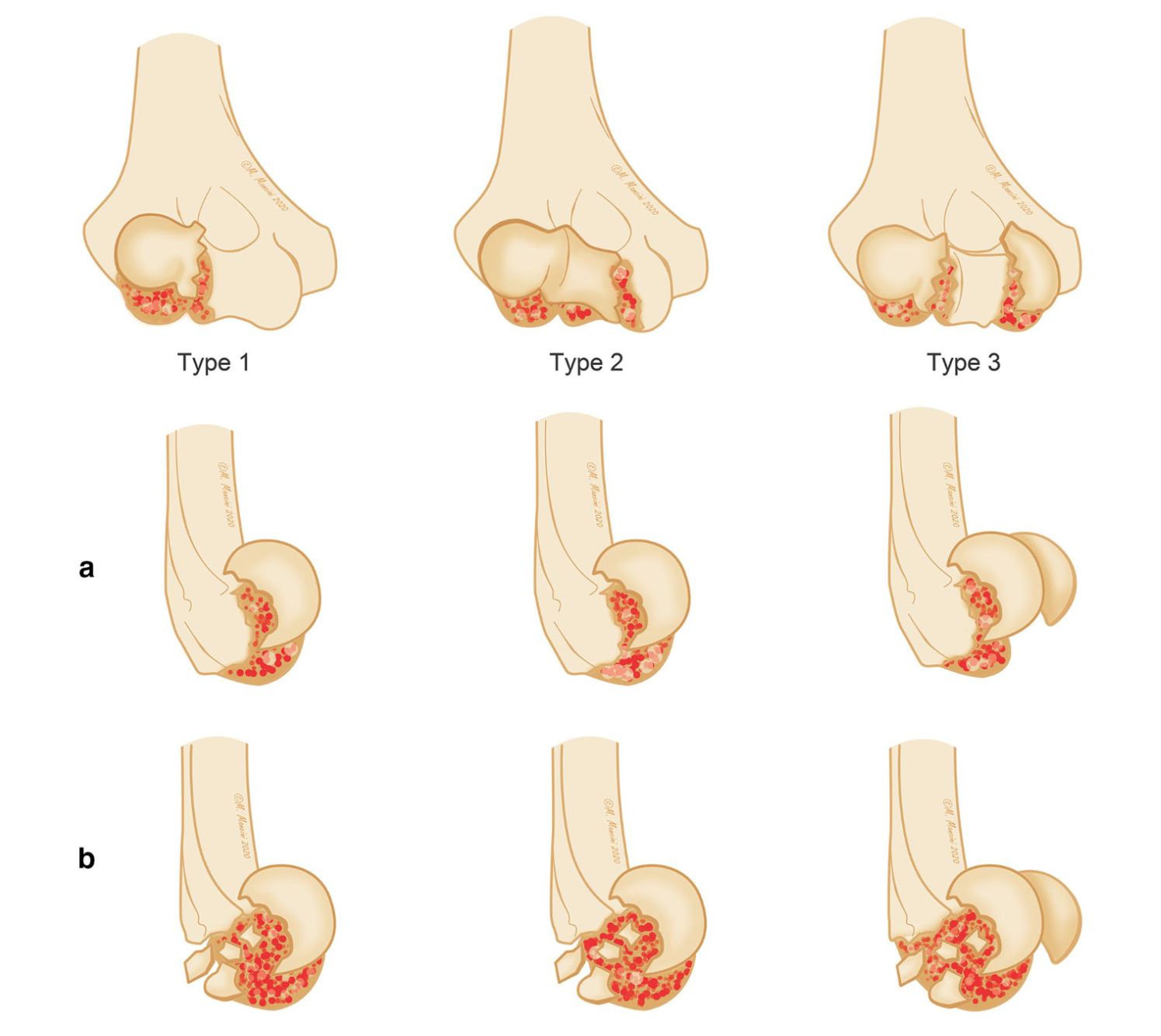
Coronal shear fractures of the distal humerus represent less than 1% of all elbow fractures [1], but this uncommon lesion could be burdened by high complications. This kind of injury is usually caused by low-energy fall on an outstretched hand or results from a spontaneous reduction of a posterolateral dislocation, where an axial force through the radial head involves the capitellum, with a variable extension to the trochlea or to the posterior aspect of the distal humerus [2, 3].
Reported incidence is higher among females, especially associated with poor bone stock [4].
Almost 50% of shear fractures are associated with other lesions such as radial head fractures and disruption of the lateral collateral ligament (LCL) [5–7].
The complexity in surgical treatment is given by the small amount of subchondral bone available for a stable fixation [2], however conservative treatment with cast immobilization is no longer recommended because of the poor out- come and associated complications [8].
At present also the fragment excision is less used and can still be attempted for small unfixable fractures, despite a higher risk of residual instability, especially when the trochlea is involved [9, 10].
With the development of reconstructive techniques, better outcomes have been reported with surgical management based on open reduction and internal fixation [5, 12, 13].
The main purpose of surgery is to restore the congruity between articular surfaces through an anatomic reduction and stable fixation. Thanks to an early mobilization, this approach also reduces the incidence of elbow rigidity and secondary osteoarthritis. Though good-to-excellent results have been reported from several studies evaluating the functional outcomes of surgical treatment with internal fixation [11–13], no standard protocol has been proposed and limited data are available regarding outcomes and drawbacks. Purpose of this retrospective study is to evaluate the clinical and radiological outcome of coronal shear fractures treated with cannulated self-tapping headless screws, and to outline surgical tips and tricks for different fractures patterns.
Clicca sul pulsante sottostante per continuare nella lettura dell’articolo completo e visualizzare le immagini di approfondimento.